Whiskey's Dividing Lines
A drinker who loves peated Islay malt and a drinker who loves Kentucky bourbon are not really drinking the same thing. The rules that separate them explain almost everything about what lands in the glass.
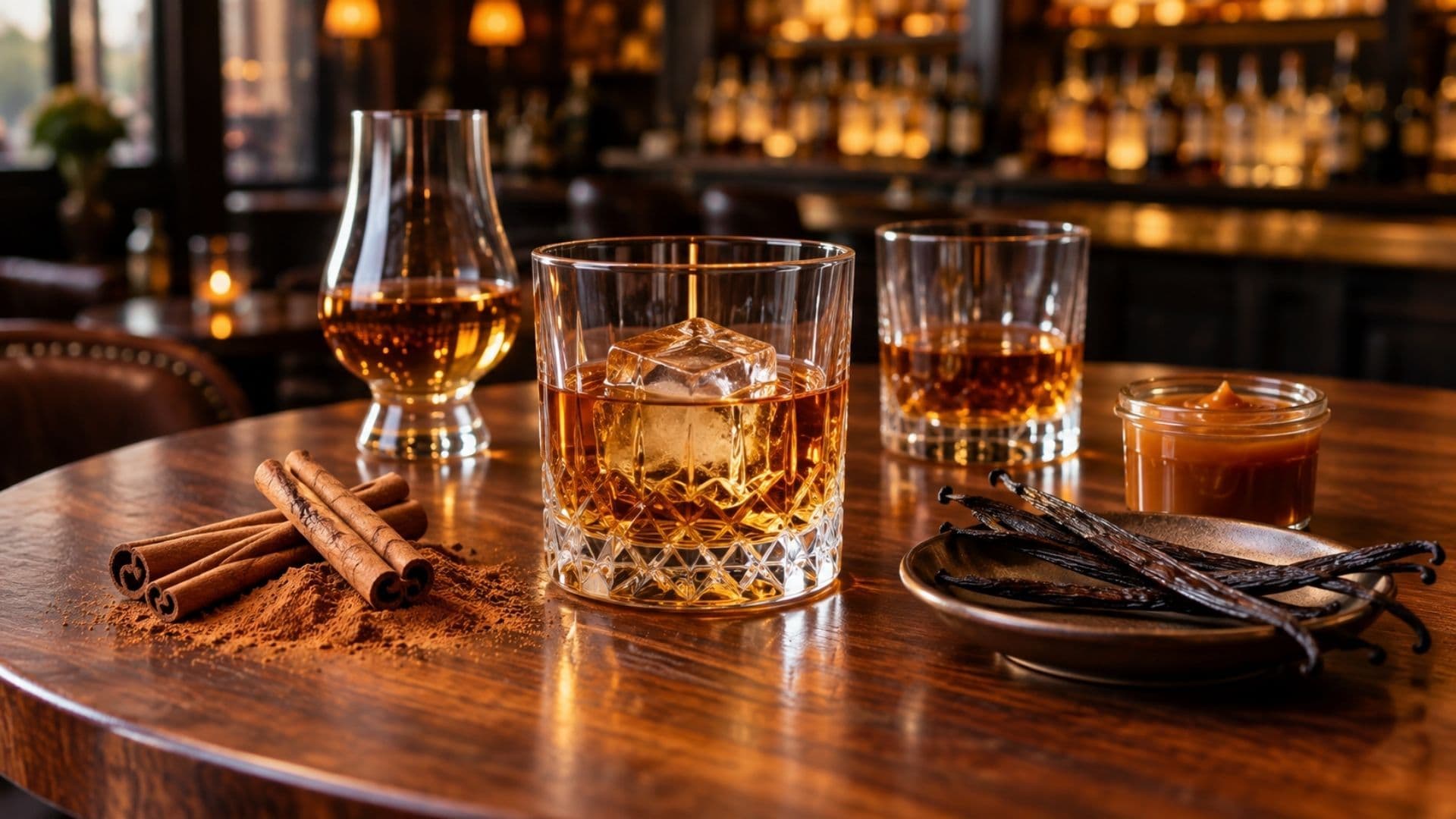
Whiskey is a single word doing an enormous amount of work. It covers a smoky spirit from a windswept Scottish island, a sweet amber pour from a Kentucky rickhouse, a soft triple-distilled bottling from County Cork, and a precise, restrained malt from the Japanese Alps. All of them begin from grain, water, and yeast. All of them spend years in oak. Yet set four of them side by side and the differences are wide enough that a drinker devoted to one can find another almost unrecognizable.
Whiskey is not one flavor. It is a family of spirits built around different grains, stills, barrels and traditions.
Even the spelling splits. Ireland and the United States generally write whiskey, while Scotland, Japan, and Canada write whisky, a small orthographic fault line that hints at how separately these traditions developed. What holds the category together is a shared method. What pulls it apart is a set of national rules, written down and legally enforced, that dictate grain, still, barrel, and time. Those rules are where the nuance lives, and learning to read them turns a crowded back bar from a guessing game into something closer to a map.
Grain, Water, Wood
Every whiskey in the world follows the same four steps. Grain is mashed with hot water to convert its starch into fermentable sugar, yeast turns that sugar into a low-strength beer, distillation concentrates the alcohol and the aromatics, and the resulting spirit rests in oak until the wood has done its work. Simple enough on paper. The variables inside those steps are what produce a category this wide.
Grain choice sets the foundation. Corn brings sweetness and a rounded body, rye delivers pepper and a dry, spicy snap, wheat contributes softness, and malted barley supplies cereal depth and the capacity to carry smoke. Still shape matters nearly as much. Pot stills work in batches and keep more of the heavy, flavorful compounds, which is why they dominate in Scotland and Ireland, while continuous column stills produce a lighter, cleaner spirit at higher volume. Then comes the barrel, which contributes a large share of the color and much of the flavor in any aged whiskey, along with climate, since a Kentucky summer drives spirit in and out of the wood far more aggressively than a cool Speyside winter. Same four steps, wildly different outcomes.
Where Do the Categories Actually Divide?
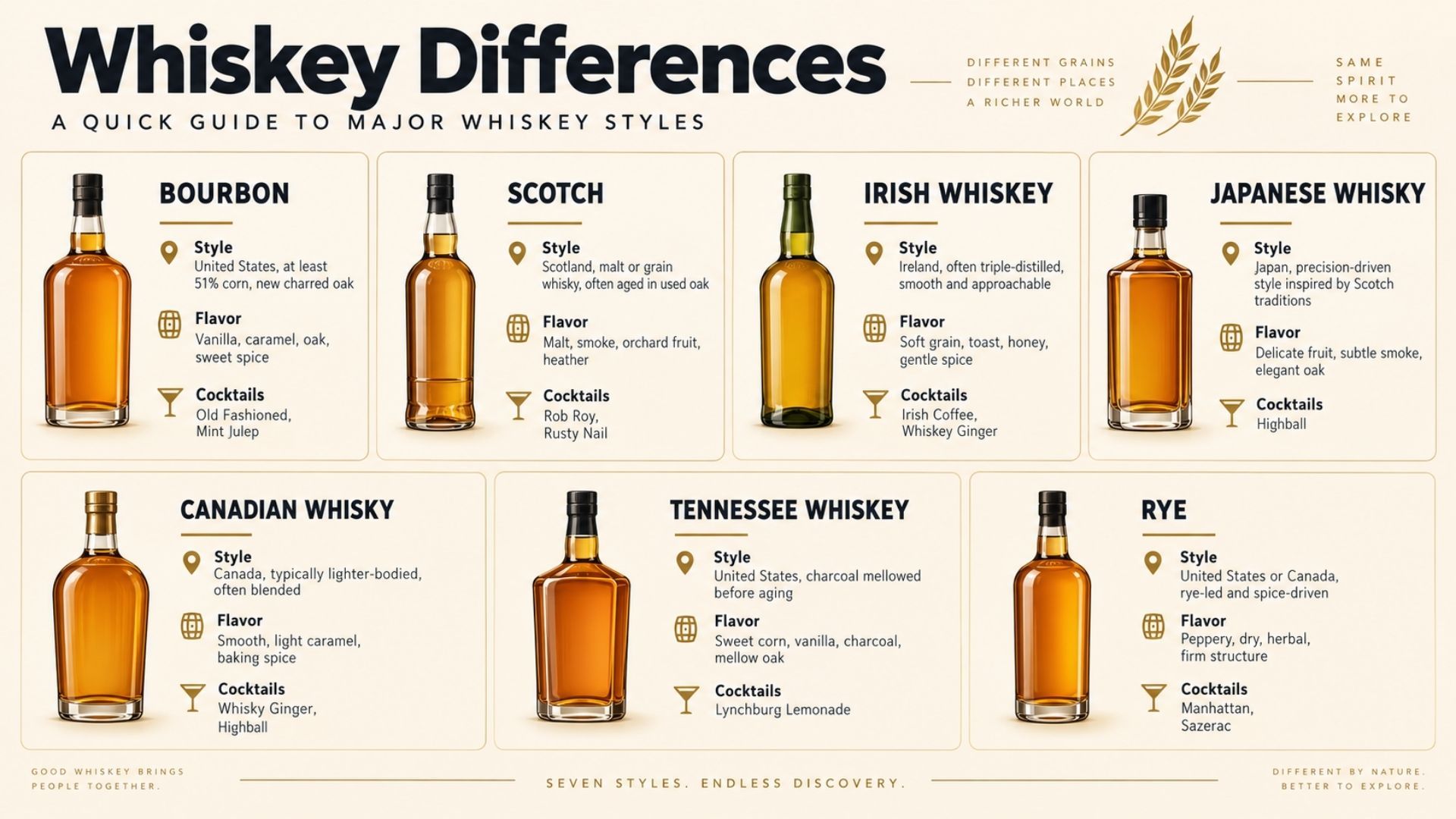
The honest answer is that whiskey categories are legal constructions before they are flavor descriptions. Bourbon must be made in the United States from a mash of at least fifty-one percent corn, distilled to no more than 160 proof, entered into new charred oak at no more than 125 proof, and bottled at 80 proof or higher, with nothing added but water. Add two years in the barrel and it earns the word straight. Rye follows the same architecture with at least fifty-one percent rye in the mash. Tennessee whiskey meets every bourbon requirement, then filters the raw spirit through roughly ten feet of sugar maple charcoal before barreling, a step known as the Lincoln County Process.
Scotland writes its rules differently. Scotch must mature at least three years in oak casks no larger than 700 liters, and single malt Scotch must come from malted barley alone, pot distilled at one distillery. Ireland also requires three years and offers a category found nowhere else, single pot still, built from a mash of both malted and unmalted barley with a minimum of thirty percent each, which gives it a peppery bite and a thicker texture than malt alone. Japan, long criticized for loose labeling, adopted formal standards in 2021 requiring that anything called Japanese whisky be made and matured in Japan.
The Barrel That Shaped the World
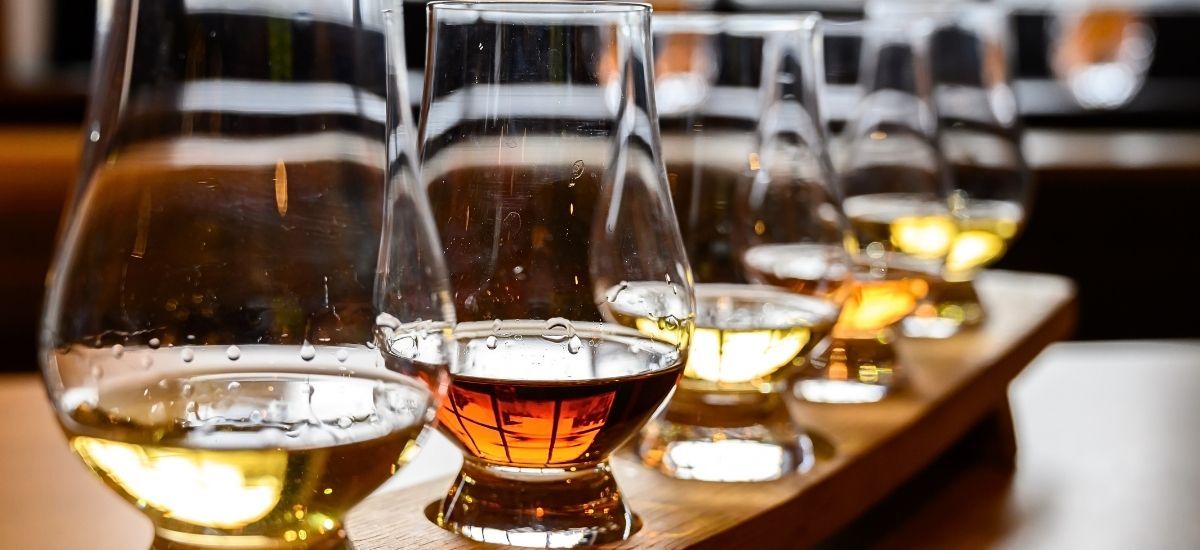
One American rule has done more to shape global whiskey flavor than any other. Bourbon must age in new charred oak, which means a distiller can use each barrel exactly once. Those barrels then leave the country by the millions, and Scotland, Ireland, and Japan buy them. The result is that a substantial share of the world's whiskey matures in wood that previously held bourbon, absorbing its residual vanilla and caramel. A regulation written to protect American coopers quietly became the flavor infrastructure of the entire category.
The other great influence is peat, the compressed bog vegetation burned to dry malted barley in parts of Scotland, which drives phenolic smoke into the grain and produces the medicinal, maritime intensity that Islay built its reputation on. Beyond those two forces, the tasting differences follow from the rules already described. Bourbon leans sweet, with vanilla, caramel, and baking spice pushed forward by that new charred wood. Rye runs drier and sharper. Irish whiskey, frequently triple distilled, arrives lighter and softer. Scotch ranges from the honeyed orchard fruit of Speyside to the smoke of the islands. Japanese whisky tends toward precision and balance, occasionally carrying the sandalwood signature of rare Mizunara oak.
The differences between the world’s whiskeys begin long before anyone decides whether to spell the word with or without an “e.” Grain determines the raw material, fermentation creates flavor, stills decide what survives distillation, barrels reshape the spirit and climate determines how quickly that transformation occurs.
The Takeaway
Whiskey now faces a market it has not seen in a generation. American whiskey volumes have fallen, Kentucky holds a record backlog of aging barrels against softening demand, major producers have paused distillation, and overall drinking rates in the United States sit at their lowest point in nearly ninety years. The boom that ran for two decades has ended, and the correction will be uncomfortable for anyone who expanded on the assumption it would continue.
What survives a contraction like this is usually whatever cannot be imitated, and that is where the rules become an asset rather than a constraint. A category defined by law has something a trend-driven product never does. Nobody can make Scotch in Ohio or Tennessee whiskey in Osaka, and no marketing campaign can manufacture the three-century relationship between Kentucky limestone water and corn, or between Irish barley and a copper pot still. As drinkers buy fewer bottles and think harder about each one, the advantage shifts toward spirits that carry a verifiable place of origin and a story that holds up under questioning. The distilleries most exposed right now are the ones that grew fastest on hype. The ones with the deepest regional roots have weathered worse. Whiskey has contracted before, in some cases nearly to extinction, and the traditions that came back were the ones tied hardest to a particular patch of ground.
Frequently Asked Questions
What is the main difference between Scotch and bourbon?
No. Peat smoke is responsible for the smoky character of certain Scotch whiskies, but many Scotch styles use little or no peat and may instead emphasize fruit, malt, honey, spice or cask character.
Is all Scotch smoky?
No. Peat smoke is responsible for the smoky character of certain Scotch whiskies, but many Scotch styles use little or no peat and may instead emphasize fruit, malt, honey, spice or cask character.
Is all Irish whiskey triple distilled?
No. Triple distillation is an important Irish tradition, but official specifications allow both double and triple distillation for some categories.
What makes bourbon taste sweeter?
Corn must make up at least 51 percent of the mash, and many bourbons use considerably more. Corn contributes a naturally rounder profile, while new charred oak adds vanilla, caramel and toasted flavors.
What is the difference between bourbon and rye?
Bourbon requires at least 51 percent corn, while American rye whiskey requires at least 51 percent rye. Bourbon often emphasizes sweetness and vanilla, while rye commonly shows more pepper, herbs and spice.
Is Canadian rye the same as American rye?
No. American rye requires at least 51 percent rye grain. Canadian regulations treat Canadian whisky and Canadian rye whisky under the same compositional standard, so a Canadian whisky labeled rye does not necessarily contain a majority of rye.
What makes Japanese whisky different?
Japanese whisky developed with significant influence from Scotch but evolved through its own distilleries, blending culture, water sources, climate and cask choices. Current JSLMA standards require compliant Japanese whisky to be fermented, distilled, matured and bottled in Japan.